Slides are a classic staple in any playground that are both fun and beneficial to early childhood development. They can be constructed using a variety of options. Slides may be referred to as one of nine different types describing either their shape, material, construction, or chute type.
Read on to learn more about playground slides, the various options, and the advantages and disadvantages that the different combinations have.
Straight Slides
Straight slides are the traditional playground slide. On a straight slide, the chute goes downward at an angle in a straight line. It does not turn, curve, or wave. The angle of the chute will vary depending on what age group the slide is designed for.

The Consumer Product Safety Commission standards for straight slides are as follows:
| Age group | Average Incline of Slide | Maximum Slope of any Point |
| Toddlers | No more than 24-degrees | 30-degrees |
| Pre-school and older | No more than 30-degrees | 50-degrees |
Per the Consumer Product Safety Commission, the chute of a slide must have raised sides on either side. The sides “should be an integral part of the chute, without any gaps between the sides and the sliding surface.” The minimum vertical height for the sides of an open chute is 4 inches.
No products found.
Curved Slides
Curved slides add a little more excitement as the sliders take on twists and turns.
Typically, curved slides come in two basic shapes:
- L-shaped – The slide turns at a 90-degree angle.
- J-shaped – The slide turns make a 180-degree turn to exit in the opposite direction of their start.
While L-shaped and J-shaped are the typical curved slide shapes, slides may also curve back and forth in a wave pattern. These slides must meet the same standards as straight slides where applicable.
Spiral Slides
If a curved slide is more exciting than a straight slide, then spiral slides are the next step. In addition to more turns and twists, the rider can’t necessarily see where they are going.

A spiral slide slopes downward and curves continually around until the exit. This is different from a curved slide; on a spiral slide, the rider will turn nearly 360-degrees or more. Spiral slides must also meet the same standards as a straight slide where applicable.
It is recommended that spiral slides for toddlers and preschool-aged children should be shorter with only one 360-degree turn or less. This is because of this age group’s underdeveloped balance and posture control.
Metal Slides
Metal is one potential material that a playground slide may be made from. Metal slides are typically stainless steel or anodized aluminum. Steel slides are the classic playground slide.
The metal is sandblasted to give it a smooth surface. The metal is typically treated with a heat-coating such as epoxy resin or powdered paint to reduce the surface temperature on hot days.
The following chart outlines the pros and cons of metal slides:
| Pros of Metal Slides | Cons of Metal Slides |
| Durable | Can reach dangerous temperatures on hot days |
| Slicker surface means children slide faster | Can rust |
| No static discharge – great for children with cochlear implants | Expensive |
| Aesthetically pleasing to the eye | |
| More resistant to vandalism – harder to break or deface |
There may be more pros than cons for metal slides, but the potential for burns on a hot day is one significant disadvantage of metal slides. As mentioned before, metal slides are typically treated to reduce surface heat.
However, some metal slides aren’t treated at all, and even if a slide is treated, the heat-coating can wear off from friction over time. Therefore, you should always be wary of burns when using metal slides.
Plastic Slides
Another option for slide material is plastic. The most common plastic used for slide production is high-density polyethylene or HDPE. Slides are sometimes made of low-density polyethylene, but HDPE is the harder and more durable option.
No products found.
The pros and cons of plastic sides are outlined in the following chart:
| Pros of Plastic Slides | Cons of Plastic Slides |
| Cheaper | Static electric discharge can interfere with cochlear implants |
| Easy to clean | More susceptible to vandalism as they are easier to deface and damage |
| Does not get as hot as metal | Will degrade over time |
| More versatile | |
| Easier to maintain and repair | |
| Can be recycled |
Plastic Slides Can Still Get Hot
Although a plastic slide will not get as hot as a metal slide, they can still present a burn hazard.
A study in Arizona measured the surface temperature of a molded plastic slide that was in direct sunlight at 161-degrees Fahrenheit. For reference, the air temperature on this particular day was 106-degrees Fahrenheit. (Source: Science Daily)
Relief for Hot Slides
Providing shade over playground equipment can greatly decrease surface temperature. The same slide that was 161-degrees Fahrenheit in the sun was 111-degrees Fahrenheit in the shade of a tree.
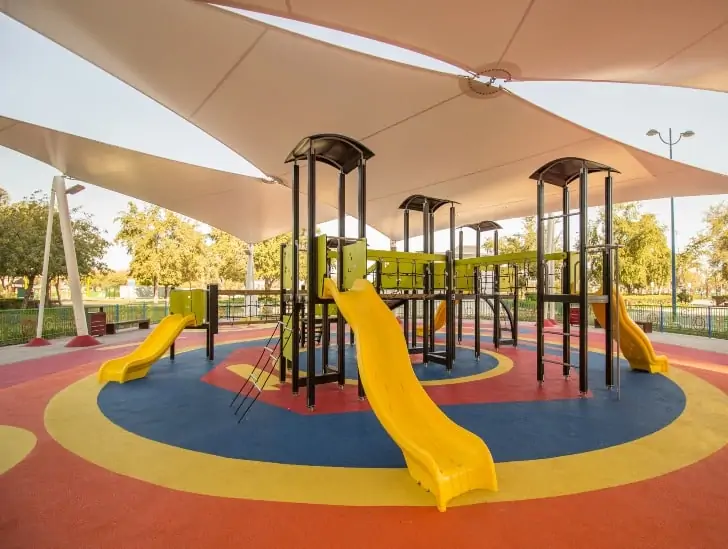
While 111-degrees Fahrenheit is still very hot, it is only 5-degrees warmer than the ambient air temperature on that given day. If trees are not an option, a shade-sail can be added to provide shade for your slide.
Stand-alone Slides
A stand-alone slide is one that is not attached to any other playground equipment. A stand-alone slide will require some form of access to the platform of the slide. This can be a ladder or a set of stairs.
With stand-alone slides, you get visibility from all sides, but there is less play potential for the amount of space required to set it up.
Component Slides
A component slide is one that is constructed as a part of a larger composite playground structure. On a composite playground, access to the slide will be gained from some other part of the playground.

The following chart gives the pros and cons of composite slides:
| Pros of Component Slides | Cons of Component Slides |
| Children have less distance between play options | Less visibility |
| Requires less space than multiple stand-alone play options |
Open Chute
Open chutes are the common option of chute type. They allow the slider to experience the world around them as well as letting anyone standing around observe the action as well. This is beneficial to parents or care-takers trying to keep an eye on their children.
Another variation of the open chute slide is the roller-slide. Roller-slides are made of numerous parallel cylindrical rollers. This adds a different tactile sensory experience, which can be calming for children with sensory processing issues. (Source: GameTime)
Tubed Chute
Tubed chutes are either partially enclosed or completely enclosed from the time the slider leaves the platform to when they reach the exit. This can potentially be more exciting for the riders. Much like with the spiral slides, the rider cannot see where they are going.

There should be some sort of barrier that prevents children from climbing on top of or sliding on the outside of the tube. The inner diameter of a tube chute must be a minimum of 23 inches.
Variations
Despite there being nine types of slides, a slide will ultimately be made up of a combination of different shapes, materials, constructions, or chute types.
24 possible slide combinations can be made from the following options:
| Construction | Chute | Shape | Material |
| Stand-alone | Open | Straight | Metal |
| Composite | Tubed | Curved | Plastic |
| – | – | Spiral | – |
Benefits of Slides
Some of the benefits of slides include:
- Climbing improves upper and lower body strength as well as cardiovascular health.
- Climbing and sliding help with learning spatial awareness.
- Climbing and sitting to slide helps build balance and coordination.
- Slides help develop social skills.
In addition to learning to share and take turns, slides help children “learn to recognize the different developmental abilities of others, and this helps establish patience and tolerance.” (Source: TFHarper)
Conclusion
Slides are a fun, beneficial addition to a playground. With the nine slide types and the variations that come from combining them, you can have a slide or slides that suit the developmental, safety, and play needs of nearly any age group or demographic.
Last update on 2023-07-23 / Affiliate links / Images from Amazon Product Advertising API